Helping community healthcare organizations align technology with what really matters.

Fractional CTO leadership for healthcare organizations that value clarity, reliability, and measurable results.

How We Help
Healthcare Dashboard

Discovery Diagnostic

A focused two-week assessment of your technology, teams, and processes.

  • Scorecard across all 7 Metrics
  • Executive summary of findings
  • Clear roadmap for what to tackle first

A 90-day engagement to align leadership and IT on priorities and build momentum.

  • Priority roadmap with clear milestones
  • Leadership and IT aligned on goals
  • Monthly progress reviews to track results

0001-3915237484737475846

Fractional CTO Partnership

Ongoing CTO leadership for organizations that need strategic guidance without a full-time hire.

  • Oversight of internal teams and vendors
  • Monthly reviews of your 7-Metric scorecard
  • Strategic planning and crisis support


Not ready to book a call?

Start with a quick self-assessment

See How Your Technology Health Scores across the 7 Metrics


About Us

Our Story

Metric7 was founded on a simple idea: technology should support your mission, not get in the way.

After years leading digital transformation in complex organizations, we saw too many teams overwhelmed by systems that made care harder, not easier.

We set out to change that by helping community health leaders bring clarity, reliability, and measurable progress to their technology operations.

Our Expertise

We help community healthcare organizations turn scattered technology into reliable systems that support patient care, not hinder it.

Our fractional CTO model brings the clarity and structure of an experienced technology leader without the overhead, so your team can focus on patient care, compliance, and community impact.

Every engagement starts with listening, then building a roadmap you can actually use.

Aligned with Your Mission

We’re not here to sell you software.

We’re here to help you make sense of what you have, connect the pieces, and plan what's next.

Metric7 stays vendor-agnostic, so our guidance always points to what’s best for your organization and the patients you serve.

CLHP_Bio_Image

Meet the Founder

Headshot

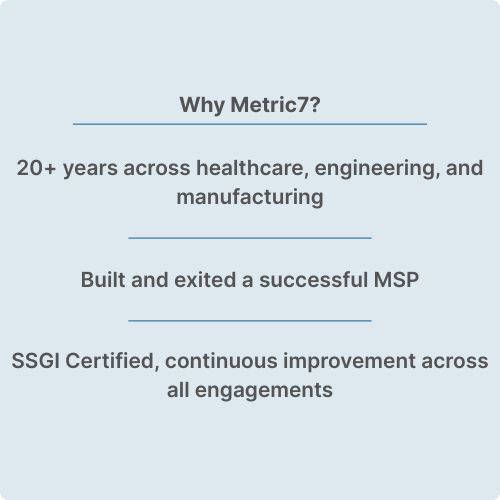
Metric7 was founded by Chip Severance, a technology leader who has spent over 20 years helping organizations bridge the gap between technology and mission.

As a former IT service provider CEO, he's led digital transformations and system optimization projects across healthcare, engineering, and manufacturing - from startups to large institutions.

His philosophy is simple: technology should serve people, not the other way around.

Chip is a Certified Lean Healthcare Professional (SSGI), focused on bridging technology and continuous improvement in community healthcare.

Hear from Chip

In this short video, Chip shares how community healthcare teams can bring clarity and confidence to their technology decisions.

If you're exploring ways to align leadership, process, and technology, this gives you a sense of our approach.


FAQ

Before starting a project with Metric7, leaders often ask a few of the same questions. Here's how we work:

Who will I actually work with?

Every engagement is led personally by me. I don’t hand you off to a junior consultant or disappear after the kickoff call. You’ll have direct access to an experienced technology leader who’s been in the seat—building systems, managing teams, and driving outcomes.

When extra hands or specialists are needed, I coordinate them to keep your project moving efficiently and consistently with your goals.

How is a fractional CTO different from a managed IT provider?

Managed IT keeps your technology running day to day—backups, updates, support tickets. A fractional CTO helps you decide what to run and why.

Metric7 focuses on alignment, reliability, and measurable progress. Instead of fixing symptoms, we look at how systems fit your mission, where data connects (or doesn’t), and how to build the right roadmap for growth.

Managed IT keeps the lights on; a fractional CTO makes sure they’re lighting the right path.

Can Metric7 help if we already have an IT team?

Absolutely—and that’s often where the biggest wins happen. Most internal IT teams are busy keeping operations stable. I bring structure, perspective, and leadership bandwidth so they can perform at their best. Together, we build systems and processes that scale instead of adding more to their plate.

It’s not about replacing your team—it’s about helping them succeed with clearer direction and better tools.

What does a Strategic Sprint look like?

A Strategic Sprint is a focused, time-boxed engagement—typically ninety days —designed to create clarity fast.

We start by mapping your current state against the 7 Metrics, then define the one or two highest-impact systems or processes to fix first.

From there, we deliver a practical roadmap, data-driven baseline metrics, and early wins your team can see immediately.

It’s short, intense, and built to show measurable progress—not another long consulting project that drags on indefinitely.

What size organizations are the best fit?

Most Metric7 clients are community health centers, multi-site clinics, or mission-driven organizations with 50–500 staff.

They usually have some IT capability already, but feel like technology is lagging behind their mission or causing friction instead of flow.

If you’re big enough to need structure but small enough to value agility, you’re probably in the sweet spot.

Metric7 FAQ Image

Insights

I Stopped Being Curious Too Soon

Early in my MSP days, I spoke with a prospect who needed IT support. We talked through their current pain points and general setup over the phone, and I thought I understood what they needed. I met them onsite for an assessment, everything seemed straightforward, and we signed the agreement. Then I discovered the legacy server. It was running old software that nobody had mentioned. It wasn't in any documentation or located with any other IT equipment, but it was part of a critical workflow that only their previous IT person understood. And I had completely missed it. I had just committed to keeping their systems running, and there was a single point of failure sitting on their network that I knew nothing about. If that server failed, a critical workflow stopped. And I was now responsible for fixing it. I paid a specialist out of pocket to migrate that system to something supportable. That cost was on me, not the client. Here's what I learned: I stopped being curious too soon. I did a standard assessment, asked standard questions, and saw what I expected to see. A few more questions would've surfaced that legacy system before we signed anything. Curiosity isn't about doubting your expertise. It's about staying open to what you don't know yet. The questions that feel obvious or redundant often surface the things nobody thought to mention. If you're walking into a situation thinking you already know the answer, you've probably stopped asking the right questions.
Jan 29, 2026

The First Explanation Isn't Enough

Years ago, I worked on a complex machine project. I was responsible for electrical systems, controls, and mechanical assembly. Another engineer handled the mechanical design and coordinated with machine shops. And then there was Mike, an engineering consultant with decades of senior design and project experience. Mike seemed like a wizard. He asked brutally efficient questions that cut straight to the root of whatever issue we were facing. And there were a lot of issues. Drawings from the design team made parts nearly impossible to assemble correctly. I'd find the problems during assembly and mark up drawings for rework. Control system limitations meant certain calculations couldn't happen onboard, they had to be precalculated in lookup tables. Lead times kept colliding with project timelines. Mike didn't have more technical knowledge than the rest of us. What made him effective was his refusal to accept the first explanation. He kept asking questions until the real issue surfaced, even when it made people uncomfortable. Here's what I learned watching him work: as an outsider coming into an organization, your initial context is shaped entirely by whoever contacts you first. That person has their version of the problem. If you're not careful, you solve their problem instead of the organization's problem. Those aren't always the same thing. Mike understood this. He didn't stop at the first explanation. He asked questions across departments, challenged assumptions, and gathered context beyond his initial contacts before committing to a solution. That's what makes outside perspective valuable. Not that you see everything immediately, but that you're not locked into any one person's version of reality. You can ask the questions that people inside the organization have stopped asking because they already "know" the answer. The discipline isn't in having perfect insight from day one. It's in staying curious long enough to make sure you're solving the right problem for the whole organization, not just the person who hired you.
Jan 26, 2026

Staying Open to Being Wrong

I'm reading "Think Again" by Adam Grant, and one idea keeps showing up in my work: the hardest part of solving problems isn't finding the solution. It's staying open to the possibility that your solution is wrong. Most of us approach problems like prosecutors. We form a hypothesis, gather evidence, defend our position. The deeper we get, the harder it becomes to pivot when new information suggests we're solving the wrong thing. This happens to everyone. Vendors, internal teams, consultants, executives. You diagnose the issue, commit to a direction, then new context arrives that changes everything. The first diagnosis isn't wrong because someone failed. It's incomplete because context is always incomplete at the start. The organizations that solve problems well aren't the ones that get it right immediately. They're the ones willing to treat solutions as hypotheses, not conclusions, and they reward people for making course corrections early instead of defending the original plan. That takes humility, but it also takes confidence. If new information is making you question your approach, that's not failure. The question is whether you're willing to follow where it leads.
Jan 22, 2026

Let's Talk About Your Technology

Start with a short conversation - no sales pitch, just a clear look at where your systems are working and where they're not.