Helping community healthcare organizations align technology with what really matters.

Fractional CTO leadership for healthcare organizations that value clarity, reliability, and measurable results.

How We Help
Healthcare Dashboard

Discovery Diagnostic

A focused two-week assessment of your technology, teams, and processes.

  • Scorecard across all 7 Metrics
  • Executive summary of findings
  • Clear roadmap for what to tackle first

A 90-day engagement to align leadership and IT on priorities and build momentum.

  • Priority roadmap with clear milestones
  • Leadership and IT aligned on goals
  • Monthly progress reviews to track results

0001-3915237484737475846

Fractional CTO Partnership

Ongoing CTO leadership for organizations that need strategic guidance without a full-time hire.

  • Oversight of internal teams and vendors
  • Monthly reviews of your 7-Metric scorecard
  • Strategic planning and crisis support


Not ready to book a call?

Start with a quick self-assessment

See How Your Technology Health Scores across the 7 Metrics


About Us

Our Story

Metric7 was founded on a simple idea: technology should support your mission, not get in the way.

After years leading digital transformation in complex organizations, we saw too many teams overwhelmed by systems that made care harder, not easier.

We set out to change that by helping community health leaders bring clarity, reliability, and measurable progress to their technology operations.

Our Expertise

We help community healthcare organizations turn scattered technology into reliable systems that support patient care, not hinder it.

Our fractional CTO model brings the clarity and structure of an experienced technology leader without the overhead, so your team can focus on patient care, compliance, and community impact.

Every engagement starts with listening, then building a roadmap you can actually use.

Aligned with Your Mission

We’re not here to sell you software.

We’re here to help you make sense of what you have, connect the pieces, and plan what's next.

Metric7 stays vendor-agnostic, so our guidance always points to what’s best for your organization and the patients you serve.

CLHP_Bio_Image

Meet the Founder

Headshot

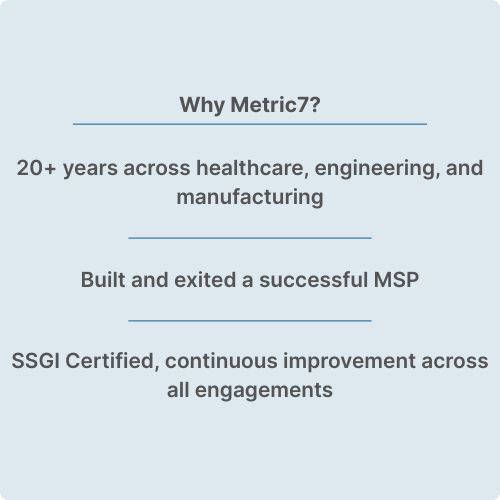
Metric7 was founded by Chip Severance, a technology leader who has spent over 20 years helping organizations bridge the gap between technology and mission.

As a former IT service provider CEO, he's led digital transformations and system optimization projects across healthcare, engineering, and manufacturing - from startups to large institutions.

His philosophy is simple: technology should serve people, not the other way around.

Chip is a Certified Lean Healthcare Professional (SSGI), focused on bridging technology and continuous improvement in community healthcare.

Hear from Chip

In this short video, Chip shares how community healthcare teams can bring clarity and confidence to their technology decisions.

If you're exploring ways to align leadership, process, and technology, this gives you a sense of our approach.


FAQ

Before starting a project with Metric7, leaders often ask a few of the same questions. Here's how we work:

Who will I actually work with?

Every engagement is led personally by me. I don’t hand you off to a junior consultant or disappear after the kickoff call. You’ll have direct access to an experienced technology leader who’s been in the seat—building systems, managing teams, and driving outcomes.

When extra hands or specialists are needed, I coordinate them to keep your project moving efficiently and consistently with your goals.

How is a fractional CTO different from a managed IT provider?

Managed IT keeps your technology running day to day—backups, updates, support tickets. A fractional CTO helps you decide what to run and why.

Metric7 focuses on alignment, reliability, and measurable progress. Instead of fixing symptoms, we look at how systems fit your mission, where data connects (or doesn’t), and how to build the right roadmap for growth.

Managed IT keeps the lights on; a fractional CTO makes sure they’re lighting the right path.

Can Metric7 help if we already have an IT team?

Absolutely—and that’s often where the biggest wins happen. Most internal IT teams are busy keeping operations stable. I bring structure, perspective, and leadership bandwidth so they can perform at their best. Together, we build systems and processes that scale instead of adding more to their plate.

It’s not about replacing your team—it’s about helping them succeed with clearer direction and better tools.

What does a Strategic Sprint look like?

A Strategic Sprint is a focused, time-boxed engagement—typically ninety days —designed to create clarity fast.

We start by mapping your current state against the 7 Metrics, then define the one or two highest-impact systems or processes to fix first.

From there, we deliver a practical roadmap, data-driven baseline metrics, and early wins your team can see immediately.

It’s short, intense, and built to show measurable progress—not another long consulting project that drags on indefinitely.

What size organizations are the best fit?

Most Metric7 clients are community health centers, multi-site clinics, or mission-driven organizations with 50–500 staff.

They usually have some IT capability already, but feel like technology is lagging behind their mission or causing friction instead of flow.

If you’re big enough to need structure but small enough to value agility, you’re probably in the sweet spot.

Metric7 FAQ Image

Insights

How Do You Think Strategically When You're Always Firefighting?

Community health centers operate under pressure that most organizations never experience. Demand for services increases year after year. Budgets stay flat or shrink. Regulatory requirements multiply. Staffing shortages force teams to do more with less. And through it all, the mission remains: provide care to the people who need it most. This creates a peculiar kind of trap for leadership. You know you need to step back and think strategically. You know that addressing root causes would eliminate recurring problems. You know that reactive firefighting is expensive and exhausting. But when do you actually have time for that work? Your morning starts with a system outage that affects patient check-ins. By lunch, you're covering for a staffing gap in the clinic. By end of day, you're prepping documentation for a compliance review. Tomorrow brings a different set of fires, but the pattern repeats. Strategic thinking requires space, and space is the one resource you absolutely don't have. The Real Cost of Constant Firefighting Here's what happens when organizations stay locked in firefighting mode: problems don't get solved; they get managed. The same issues surface again and again, just with different details. Your team develops workarounds that become permanent fixtures. Technology that should make work easier instead creates friction. And the gap between where you are and where you need to be keeps widening. This isn't a failure of leadership. It's a structural problem. Mission-driven organizations are asked to do impossible things with limited resources, and the daily demands are real and urgent. You can't ignore the fires. People depend on you. But you also can't keep fighting the same fires forever. What Breaking the Pattern Looks Like I've seen this play out in organizations over the years. A leadership team that's been firefighting for months finally pauses long enough to map out where the friction actually lives. They discover that three separate "technology problems" all trace back to poor data quality in one system. Or that staff frustration with "unreliable systems" is actually about one vendor who consistently misses deadlines. Once you see the pattern, the path forward gets clearer. Not easy, but clearer. You know what to prioritize. You know where effort will actually pay off. You stop wasting energy on symptoms and start addressing causes. The challenge is creating enough clarity to see those patterns when you're in the middle of the chaos. You don't need perfect information. You need a way to organize what you already know. That's exactly why the 7-Metric Assessment exists. It's not a comprehensive technology audit. It's a structured way to see where the real friction lives. A few minutes to answer 21 questions, and you get back a scorecard that shows you which recurring fires share the same root cause. Making the Time I won't pretend this is easy. The fires are real. The demands on your time are legitimate. But staying locked in firefighting mode has a cost too: exhaustion, burnout, recurring problems that never get solved, and technology that creates more work instead of less. You don't need a weekend retreat to think strategically. You need clarity on where to focus. And clarity doesn't require unlimited time. It just requires asking better questions. The assessment is available here. It only takes a few minutes, and it might surface something worth your attention. Because the only way out of the firefighting trap is seeing the pattern clearly enough to break it.
Dec 11, 2025

What to Do After You Know Your Technology Score

You've completed the 7-Metric Assessment. You have your scorecard. Now what? Most leaders look at their results and immediately want to fix everything at once. That instinct makes sense, but it's counterproductive. Technology health isn't improved by tackling every problem simultaneously. It's improved by understanding patterns, choosing the right starting point, and building momentum. Here's how to make sense of your results and decide what actually matters. Read the Pattern, Not Just the Numbers Individual scores tell you something. The pattern across all seven metrics tells you more. If you scored low across the board, that's not a crisis. It means you're honest about where you stand, and you have clear opportunities for improvement. The question isn't "how did we get here?" It's "which one problem, if addressed, would make the biggest difference?" If most scores are high but one or two are conspicuously low, pay attention to that gap. A clinic with strong alignment, security, and quality but terrible efficiency usually has a workflow problem, not a technology problem. The systems work fine. The processes around them don't. If scores cluster in the middle, you're probably doing okay but nothing feels exceptional. That's common. It also means small improvements in any direction will be noticeable quickly. What Different Score Ranges Mean Developing (below 50%): These areas create daily friction. Staff works around problems instead of through them. Leadership notices, even if they don't always say so. These are your highest-impact opportunities because the gap between current state and functional state is measurable. Maturing (50-79%): Things mostly work, but inconsistently. You have the foundation, but it's not reliable enough to trust completely. These areas benefit from structure and process more than new technology. Leading (80% and above): You're doing well here. The question isn't how to improve, it's how to maintain without creating bureaucracy. High scores can slip quickly if you stop paying attention or if you over-engineer solutions that already work. Pick One Problem to Solve First Look at your lowest score. Now ask yourself: does this problem show up every week? Does it pull focus from patient care? Does it create frustration that people talk about? If yes, that's your starting point. If your lowest score is in an area that's annoying but not urgent, look at the second-lowest score. The goal is to find the problem that, if solved, would give your team the most immediate relief. Don't try to fix three things at once. You'll split attention, dilute effort, and nothing will improve meaningfully. Pick one metric. Focus there. Build momentum. Then tackle the next one. When You Can Handle It Internally Some low scores are fixable with internal effort: Alignment problems often need better communication between leadership and IT, not new tools. If your score is low here, start with monthly check-ins where priorities get revisited and projects get tied directly to mission outcomes. Quality issues around data usually come from inconsistent processes, not bad systems. Standardize how information gets entered. Assign ownership for accuracy. Run regular audits. These are internal fixes. Innovation gaps can often be addressed by creating a lightweight process for documenting what works when someone tries something new. You don't need a formal innovation program. You need a way to capture and share small wins. When You Need Outside Help Other low scores signal deeper problems that require expertise or capacity you don't have: Reliability problems might stem from infrastructure issues, vendor limitations, or technical debt that's compounded over time. If systems go down often or recovery is slow, you need someone who can evaluate the architecture and recommend structural fixes. Security gaps in the Developing range usually mean you're exposed in ways you don't fully understand. Security isn't just about tools. It's about posture, processes, and knowing where vulnerabilities actually exist. That requires specialized knowledge. Efficiency issues that persist despite process improvements often point to workflow design problems or systems that don't integrate well. If staff are still doing manual workarounds after you've tried to streamline, the problem is probably technical, not procedural. What Happens Next If your results point to problems you can tackle internally, start with the one that causes the most friction. Use the targeted guidance in your scorecard as a starting point. Revisit the assessment in three to six months and see if your score moved. If your results reveal gaps that need outside perspective, that's where the Discovery Diagnostic comes in. It takes your scorecard findings and turns them into a practical roadmap. We'll identify root causes, prioritize based on impact and feasibility, and give you a clear plan for what to do first. The Discovery Diagnostic isn't about selling you services. It's about giving you clarity. Some clinics come out of it with a roadmap they execute internally. Others decide they need ongoing support. Either way, you'll know exactly what needs to happen and why. You can also book a shorter call to discuss your results and get perspective on whether you're on the right track. No pitch, just a conversation about what you're seeing and what makes sense as a next step. The scorecard gave you a snapshot. Now you get to decide how to act on it. Whether you work with Metric7 or handle this on your own, the important thing is that you're not guessing anymore. You have a starting point, and that's more than most clinics have. If you want to talk through your results in a quick 15-minute debrief, book a time here. If you're interested in exploring a Discovery Diagnostic, schedule a 30-minute conversation. And if you just want to sit with your results for a while and think it through, that's fine too. The scorecard isn't going anywhere.
Dec 8, 2025

What Your IT Scorecard Actually Tells You (And What It Doesn't)

Most technology assessments promise detailed insights but deliver generic recommendations that could apply to anyone. If you're considering the 7-Metric Assessment, you probably have some healthy skepticism about numerical scores. Fair question. Here's what the scorecard reveals and what it leaves out. What the Scorecard Does Tell You The 7-Metric Assessment measures your perception of how technology is performing. These are subjective answers based on what you observe every day. A more scientific approach would involve collecting specific metrics and analyzing data patterns. That kind of deep analysis has its place, but it takes weeks, not minutes. The 7-Metric Assessment gives you something different: a structured way to organize what you already know. Patterns and priorities. Low efficiency and low quality often point to the same root cause. High alignment but low reliability means leadership knows what they want, but systems can't deliver it. The scorecard shows you where issues are connected and which gaps create the most friction. Visibility gaps. Questions you couldn't answer confidently are as revealing as the scores themselves. If you're unsure whether your team can recover quickly from an outage, that uncertainty points to communication gaps that matter. Shared language. Instead of "IT is frustrating," you can say "we're at 40% on efficiency." That shift from complaint to observation changes the conversation. What the Scorecard Doesn't Tell You Root causes. A low reliability score tells you systems are unreliable. It doesn't tell you whether that's because of aging infrastructure, poor vendor support, understaffing, or lack of processes. Implementation details. The scorecard points you toward problem domains and offers directional guidance. It doesn't give you a step-by-step plan, timeline, or cost estimate. Whether you need outside help. Some low scores can be addressed with internal effort. Others require expertise or capacity you don't have. The scorecard doesn't make that determination for you. Why Subjective Scores Still Matter Perception drives decisions. If your leadership team believes systems are unreliable, they'll make choices based on that belief. And most of the time, those perceptions are grounded in real experience. You know when workflows feel clunky. You know when security makes people nervous. You know when alignment is missing. The 7-Metric Assessment captures that knowledge and organizes it. Numerical scores create shared vocabulary across your leadership team. And if you retake the assessment in six months, you can track whether changes actually moved the needle. What to Do With Your Results Share results with your leadership team and look for patterns. Which metrics are consistently low? Which show strength? Identify the one or two lowest scores that cause the most daily friction. Read the targeted guidance for those metrics. Then decide: can you address these internally, or do you need outside perspective? The scorecard won't make that decision for you, but it will help you frame the question clearly. If your results reveal patterns you're not sure how to address, the Discovery Diagnostic takes the scorecard findings and turns them into a practical roadmap. But whether you work with Metric7 or tackle this internally, the scorecard gives you something concrete to work from. Next week, I'll share more about interpreting your results and what specific steps make sense based on different score patterns. For now, if you haven't taken the assessment yet, it's available at https://assessment.metric7.net. It takes a few minutes, and you might learn something that changes how you think about your technology landscape.
Dec 1, 2025

Let's Talk About Your Technology

Start with a short conversation - no sales pitch, just a clear look at where your systems are working and where they're not.