
Strategic leadership for growing organizations that need clarity, not complexity.
Metric7 works alongside leadership teams to cut through the noise, understand the real drivers of performance, and build momentum that lasts.
Flexible engagement models designed to meet your organization's goals.

Discovery Diagnostic
A focused two-week assessment of your technology, teams, and processes.
- Scorecard across all 7 Metrics
- Executive summary of findings
- Clear roadmap for what to tackle first

A 90-day engagement to align leadership and IT on priorities and build momentum.
- Priority roadmap with clear milestones
- Leadership and IT aligned on goals
- Monthly progress reviews to track results

Fractional CTO Partnership
Ongoing CTO leadership for organizations that need strategic guidance without a full-time hire.
- Oversight of internal teams and vendors
- Monthly reviews of your 7-Metric scorecard
- Strategic planning and crisis support
Let's figure that out together
A 30-minute conversation, no sales pitch. Just an honest look at where your organization is today and where you want it to go.
Our Story
Metric7 was founded on a simple idea: technology should support your mission, not get in the way.
After years leading digital transformation in complex organizations, we saw too many teams overwhelmed by systems that made their work harder, not easier.
We set out to change that by helping organizational leaders bring clarity, reliability, and measurable progress to their technology operations.
Our Expertise
We help mid-sized organizations turn scattered technology into reliable systems that support their mission.
Whether you're managing multiple locations, coordinating field operations, or navigating regulatory complexity, our fractional CTO model brings clarity and structure without the overhead of a full-time executive.
Aligned with Your Mission
We’re not here to sell you software.
We’re here to help you make sense of what you have, connect the pieces, and plan what's next.
Metric7 stays vendor-agnostic, so our guidance always points to what’s best for your organization.
Meet the Founder

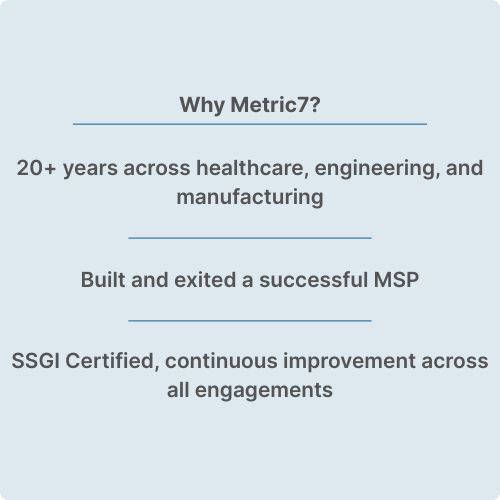
Running an MSP for over 20 years taught me a lot about keeping systems healthy. But the organizations that struggled most had something in common: their technology wasn't aligned with what they were actually trying to accomplish. That's the gap I built Metric7 around.
I've worked across healthcare, engineering, and manufacturing, and each industry has made me a sharper problem solver.
I hold an SSGI certification in continuous improvement, and I apply that mindset to every engagement.
Connect On LinkedIn
FAQ
Before starting a project with Metric7, leaders often ask a few of the same questions. Here's how we work:
Who will I actually work with?
Every engagement is led personally by me. I don’t hand you off to a junior consultant or disappear after the kickoff call. You’ll have direct access to an experienced technology leader who’s been in the seat building systems, managing teams, and driving outcomes.
When extra hands or specialists are needed, I coordinate them to keep your project moving efficiently and consistently with your goals.
How is a fractional CTO different from a managed IT provider?
Managed IT keeps your technology running day to day: backups, updates, support tickets. A fractional CTO helps you decide what to run and why.
Metric7 focuses on alignment, reliability, and measurable progress. Instead of fixing symptoms, we look at how systems fit your mission, where data connects (or doesn't), and how to build the right roadmap for growth.
Managed IT keeps the lights on. A fractional CTO makes sure they're lighting the right path.
Can Metric7 help if we already have an IT team?
Absolutely, and that's often where the biggest wins happen. Most internal IT teams are busy keeping operations stable. I bring structure, perspective, and leadership bandwidth so they can perform at their best. Together, we build systems and processes that scale instead of adding more to their plate.
It's not about replacing your team. It's about helping them succeed with clearer direction and better tools.
What does a Strategic Sprint look like?
A Strategic Sprint is a focused, time-boxed engagement, typically ninety days, designed to create clarity fast.
We start by mapping your current state against the 7 Metrics, then define the one or two highest-impact systems or processes to fix first.
From there, we deliver a practical roadmap, data-driven baseline metrics, and early wins your team can see immediately.
It's short, intense, and built to show measurable progress. Not another long consulting project that drags on indefinitely.
What kind of organizations are a good fit?
Most Metric7 clients are small and mid-sized organizations managing operational complexity.
They usually have some IT capability already, but technology creates friction instead of enabling their team.
If you are big enough to need structure but nimble enough to value agility, you are probably a good fit.