
Last week, I mentioned that Metric7's 7-Metric Assessment was nearly ready. This week, as many of us pause for Thanksgiving, I want to share how this tool actually works and why it's designed the way it is.
The assessment is built around a simple premise: technology health isn't one thing. It's a set of interconnected patterns that either support your team or create friction. To understand those patterns, you need to look at seven dimensions: alignment, reliability, security, efficiency, quality, innovation, and resilience.
What the Assessment Looks Like
The assessment includes 21 questions, three for each of the seven metrics. Each question uses a 1-5 scale, where 1 represents significant challenges and 5 represents strong performance. The questions are straightforward, and most leaders complete the assessment in about 3 minutes.
Here's what makes the 7-Metric Assessment different from other technology assessments:
The questions aren't technical. They're about outcomes, not implementation details. You don't need to know your server uptime percentage or your patch compliance rate. You need to know whether your team can rely on systems when they need them, whether data tells you the truth, and whether technology helps or hinders patient care.
The questions are designed for leaders who have visibility into operations. If you're part of the executive team, you should be able to answer them based on what you see every day. If a question makes you pause because you genuinely don't know the answer, that uncertainty is itself diagnostic. It often points to gaps in communication or visibility that matter more than you might think.
What You Get Back
When you complete the assessment, you receive a scorecard with three components: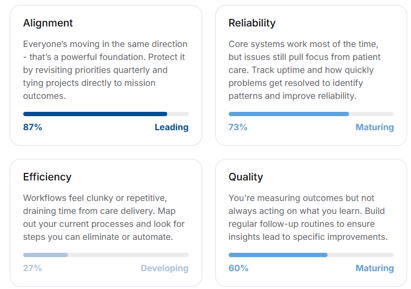
First, a composite score that reflects your overall technology health. This gives you a sense of where you stand relative to other community healthcare organizations.
Second, individual scores for each of the seven metrics. This is where the real insight lives. You might score well on reliability but struggle with alignment. Or you might have strong security practices but weak data quality. These patterns matter because they point to specific areas where small improvements can have outsized impact.
Third, targeted guidance based on your results. If you score low in a particular area, you'll see recommendations tailored to that metric. If you score high, you'll get insight into how to maintain that strength without creating new problems elsewhere.
The language in the scorecard adjusts based on your results. Low scores get practical, immediate steps. Medium scores get direction on what to prioritize next. High scores reinforce the key disciplines that are working and help you maintain that strength.
Why It's Designed This Way
I've spent years evaluating technology operations in different organizations. Most of the time, the problems aren't mysterious. Leaders know where things feel fragile. They know which systems cause frustration. They know when the team is spending too much time on workarounds.
What they don't always know is how to make sense of it all. Which problem should they tackle first? What's actually urgent versus just annoying? Where will effort pay off, and where will it just shift the pain somewhere else?
The assessment helps organize those instincts. It doesn't tell you what's wrong, it helps you see the pattern more clearly. And patterns are easier to address than scattered symptoms.
What Happens After You Take It
The scorecard is useful on its own. You can use it to start conversations with your leadership team, frame decisions about where to invest time and resources, or simply validate what you already suspected.
But it's also the starting point for deeper work. If your results show areas that need attention, and you're not sure how to address them, that's where Metric7's services come in. The Discovery Diagnostic takes the scorecard findings and turns them into a practical roadmap. The Strategic Sprint builds momentum on the highest-priority improvements. And the Fractional CTO Partnership provides ongoing guidance as your technology landscape evolves.
The assessment isn't a sales tool. It's a service. Whether you work with Metric7 or not, the scorecard gives you something concrete to act on.
A Note on Evolution
This is version one. The questions, the scoring model, and the guidance will improve over time as more organizations complete the assessment, and I learn which patterns emerge most often. I'm treating this as a living tool, one that gets better as I see how it performs in the real world.
If your results raise questions or don't quite match your experience, let's discuss what you're seeing. This tool only works if it reflects what clinics actually experience, not what I think they should experience.
During this Thanksgiving week, I'm grateful for the leaders who've already tested the 7-Metric Assessment and helped refine it. Their feedback made it sharper and more useful. If you're curious about where your clinic stands, the assessment is ready. It takes a few minutes, and it might surface something worth your attention.
You can find it here: https://assessment.metric7.net
More to come as we move into December and year-end planning season.